What Is the Mental Health Continuum? Understanding the Difference Between Thriving and Surviving
Updated: Jul 28
When we talk about mental health, we often think in extremes.
Someone is either “doing well” or they’re “struggling.”
Someone is either “fine” or they’re “not coping.”
Someone either has a mental health condition or they don’t.
But the reality is much more complex.
Mental health exists on a continuum. It changes throughout our lives, and even throughout our weeks and days. We can move between periods of thriving, coping, struggling, and feeling overwhelmed depending on what is happening around us, the support we have, and the resources available to us.
Understanding this continuum helps us move away from the idea that mental health is only something we pay attention to when things become a crisis.
It reminds us that mental health is something we all have, and something we can actively care for.
What is the Mental Health Continuum?
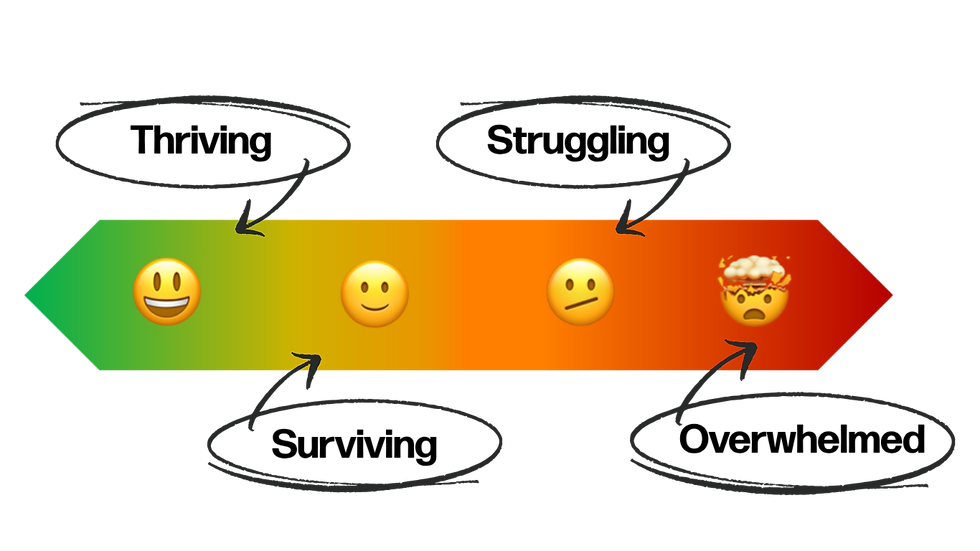
The mental health continuum is a way of understanding mental wellbeing as a spectrum rather than a simple “healthy versus unhealthy” distinction.
A model I use describes four stages:
Thriving
Coping
Struggling
Surviving
Importantly, these stages are not fixed identities, you are not a “thriving person” or a “struggling person.” You are a person moving through different experiences.
A stressful period at work, relationship breakdown, grief, illness, financial pressure, trauma, or major life changes can shift where we sit on the continuum.
.
1. Thriving: When life feels manageable and meaningful
Thriving means you generally have enough internal and external resources to navigate life’s challenges.
You might notice:
You feel connected to others
You have a sense of purpose or meaning
You can experience a range of emotions
You recover after difficult moments
You feel capable of handling challenges
You engage in activities that support your wellbeing
Thriving is not about being happy all the time.
It’s about having flexibility.
You can experience stress without feeling completely consumed by it.
You can experience sadness without losing hope.
You can experience uncertainty while still feeling grounded.
2. Coping: When things are difficult, but you’re managing
Most of us spend a lot of our lives in this space.
Coping means things may not feel easy, but you still have the capacity to meet your responsibilities and look after yourself.
You might notice:
You’re feeling stressed but still functioning
You’re tired but recovering with rest
You’re facing challenges but have support around you
You’re having difficult emotions but can process them
This stage is important because it’s often where we have the greatest opportunity to practise prevention. Many people wait until they are completely overwhelmed before seeking support. But mental health care works best when we don’t wait until we reach breaking point.
Think of it like physical health:
You don’t have to wait until you have a serious illness before you start looking after your body.
3. Struggling: When your usual coping strategies aren’t enough
Struggling is a sign that something needs attention.
It means the demands you’re facing may currently outweigh the resources you have available.
You might notice:
Feeling constantly stressed or overwhelmed
Increased anxiety or sadness
Difficulty concentrating
Changes in sleep or appetite
Losing interest in things you usually enjoy
Becoming more withdrawn
Feeling irritable or emotionally reactive
Sometimes we notice these changes in ourselves.
Sometimes other people notice first.
A partner might say:
“You don’t seem like yourself lately.”
A friend might notice:
“I haven’t heard from you as much.”
These moments can be invitations to check in with ourselves.
4. Surviving: When getting through the day feels like the goal
Surviving is when life feels incredibly difficult and your available resources are stretched beyond capacity.
In this space, people often describe feeling like they are just getting through each day.
You might notice:
Feeling hopeless or helpless
Struggling to complete everyday tasks
Feeling emotionally numb or disconnected
Experiencing intense distress
Feeling unable to cope
Having thoughts of not wanting to be alive
When we are overwhelmed, our brains naturally prioritise getting through the immediate threat rather than long-term planning, problem-solving, or growth.
This is why someone experiencing high levels of distress may struggle with things that seem “simple” from the outside.
Their brain is focused on survival.
The continuum is not a straight line
One of the most important things to understand is that movement along the continuum is normal. You might thrive in one area of your life and struggle in another.
For example:
You might feel confident and capable at work but feel overwhelmed in your relationships.
You might have strong friendships but struggle with your self-esteem.
You might appear successful on the outside while privately feeling exhausted.
Why noticing where you are matters
The earlier we notice changes in our mental health, the easier it often is to respond.
Some early warning signs might include:
Sleeping poorly
Losing motivation
Cancelling plans more often
Feeling constantly “on edge”
Becoming more critical of yourself
Using avoidance to cope
Feeling disconnected from yourself or others
Your mind and body are communicating:
“Something needs attention.”
Moving towards wellbeing: What helps us shift along the continuum?
There is no single strategy that works for everyone.
Mental health is supported through a combination of:
Connection
Humans are wired for relationships. Supportive connections help us feel understood and less alone.
Self-awareness
Learning to recognise your thoughts, emotions, behaviours, and patterns helps you respond rather than react.
Emotional processing
Difficult emotions need space to be felt and understood, not avoided, ignored, or pushed away.
Meaning and purpose
Having things that matter to us gives us motivation and direction, even during difficult periods.
Support
Sometimes our own strategies aren’t enough. Seeking support from friends, family, a counsellor, psychologist, or other services is a strength, not a weakness.

About the author
Sophie Hattch is the founder of The Tough Stuff and an ACA-registered counsellor based in Sydney offering therapy in person and online across Australia. She's also a Mental Health First Aid facilitator with a background at Lifeline. She is currently completing her Masters of Suicidology. Book a free 15-minute call to see if she's the right fit for you.

Comments