Feeling Overwhelmed? How the Eisenhower Matrix Can Reduce Stress and Decision Fatigue
Updated: Jul 28
Have you ever had so much to do that you don’t know where to start?
Your to-do list keeps growing.
Your notifications keep coming.
Everyone seems to need something from you.
And even when you finally get a moment to rest, your brain is still running through everything you haven’t done.
Modern life often asks us to manage dozens of competing priorities at once, work, relationships, family, health, finances, responsibilities, and personal goals.
The problem is not always the amount we have to do.
Sometimes it’s that our brain is trying to make hundreds of decisions without a clear system.
This is where the Eisenhower Matrix can help.
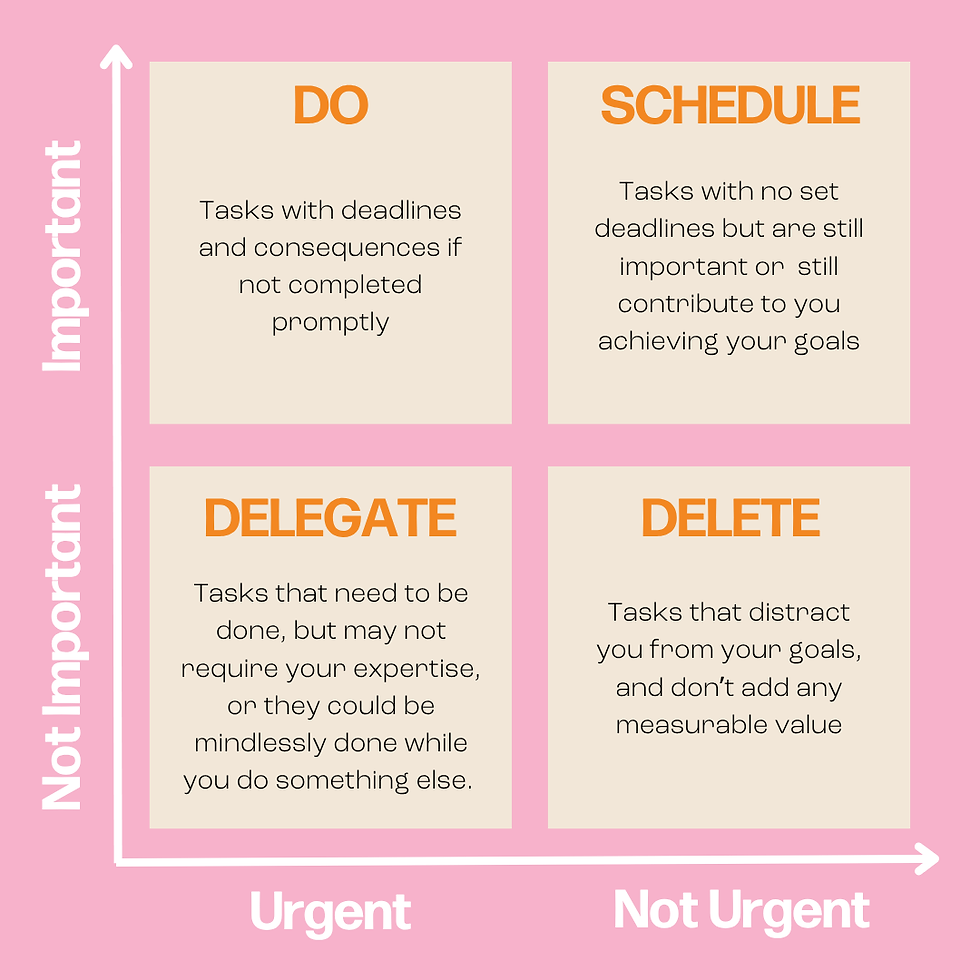
It is a simple prioritisation tool designed to help you separate what is urgent, what is important, and what can wait.
And when used well, it can reduce overwhelm, decision fatigue, and the feeling that everything is an emergency.
What is decision fatigue?
Before we look at the tool, it helps to understand why overwhelm happens.
Decision fatigue is the mental exhaustion that comes from making too many choices.
Throughout the day, your brain is constantly making decisions:
What needs my attention first?
What can wait?
What should I say yes to?
What should I say no to?
What deserves my energy?
When everything feels equally important, your brain has to repeatedly evaluate priorities.
This creates mental load.
Eventually, we may:
Avoid tasks altogether
Procrastinate
Feel paralysed by choices
React to whatever feels most urgent
Lose sight of what actually matters
The Eisenhower Matrix helps by giving your brain a framework.
Instead of asking:
“How do I do everything?”
You start asking:
“What actually deserves my attention right now?”
What is the Eisenhower Matrix?
The Eisenhower Matrix is based on a quote often attributed to former US President Dwight D. Eisenhower:
“What is important is rarely urgent, and what is urgent is seldom important.”
The idea is that tasks can be divided into four categories:
Important and urgent
Important but not urgent
Urgent but not important
Not urgent and not important
Each category requires a different response.
Quadrant 1: Important and urgent
Do it now
These are the things that genuinely require immediate attention.
Examples:
A deadline today
An urgent work issue
A health concern
A crisis that needs responding to
A significant problem that cannot wait
These tasks often create the most stress because they carry consequences if ignored.
The challenge is that many people spend their entire lives operating from this quadrant.
When everything becomes urgent, your nervous system stays activated.
You are constantly reacting rather than choosing.
Ask yourself:
“Does this genuinely need my attention today?”
Quadrant 2: Important but not urgent
Schedule it
This is the quadrant that often gets neglected — but it is where long-term wellbeing is built.
These are things that matter but do not demand immediate attention.
Examples:
Exercise
Sleep
Meal planning
Relationships
Therapy
Learning new skills
Career planning
Financial planning
Rest and recovery
These tasks are easy to postpone because there is no immediate consequence.
But over time, neglecting them often creates bigger problems.
Ask yourself:
“What would make my future self’s life easier?”
This quadrant is about prevention rather than crisis management.
Quadrant 3: Urgent but not important
Delegate or limit
These tasks often feel demanding because they are urgent.
But they may not actually align with your priorities.
Examples:
Constant notifications
Other people’s last-minute requests
Interruptions
Emails that do not require your immediate response
Tasks someone else could handle
This quadrant can be tricky, especially for people who are highly responsible or people-pleasing. But constantly prioritising everyone else’s urgency can leave no space for what matters to you.
Ask yourself:
“Is this actually my responsibility?”
or:
“Am I responding because it matters, or because I feel uncomfortable saying no?”
Quadrant 4: Not urgent and not important
Eliminate or reduce
These are tasks that take time and energy without adding much value.
Examples:
Mindless scrolling
Excessive checking of emails
Activities you do out of habit rather than choice
Unnecessary commitments
This doesn’t mean all downtime belongs here, rest, fun, and relaxation are important.
The difference is whether something genuinely restores you or simply distracts you.
Watching your favourite show after a long day may be restorative, scrolling for an hour while feeling worse afterwards may not be.
Ask yourself:
“Does this recharge me, or does it drain me?”
The Eisenhower Matrix and mental health
Prioritisation tools are not just productivity hacks.
They can support mental health because overwhelm often impacts:
Concentration
Sleep
Emotional regulation
Confidence
Motivation
Decision-making
When your brain feels overloaded, reducing the number of decisions you have to make can create a sense of control, and a sense of control is an important part of psychological wellbeing.
A wellbeing reminder: you are not a machine
Sometimes overwhelm is not a time-management problem.
Sometimes it is a capacity problem.
You may not need a better schedule.
You may need:
More rest
More support
Fewer commitments
Better boundaries
Time to recover
A full calendar does not always mean a productive life.
Sometimes the most important thing on your list is creating space.

About the author
Sophie Hattch is the founder of The Tough Stuff and an ACA-registered counsellor based in Sydney offering therapy in person and online across Australia. She's also a Mental Health First Aid facilitator with a background at Lifeline. She is currently completing her Masters of Suicidology. Book a free 15-minute call to see if she's the right fit for you.
Comments